Share your Nick Rinard Physical Therapy story.
You may just inspire someone with a similar condition to get out of pain today!
Included are hyperlinks to leave your reviews, thank you in advance!
Facebook: https://www.facebook.com/mdtclinics/
More Physical Therapy in Portland, Oregon
You may just inspire someone with a similar condition to get out of pain today!
Included are hyperlinks to leave your reviews, thank you in advance!
Facebook: https://www.facebook.com/mdtclinics/
MoreKeep moving. Nick Rinard Physical Therapy is here to help you stay active this summer.
“Frozen right shoulder.
Regained almost 100% use of shoulder / arm again!”
Gloria
MoreLateral epicondylitis, more commonly known as “tennis elbow,” is a pathology that is familiar to physical therapists and the general public. What is lesser known is “pseudo tennis elbow,” a mechanical problem with a very simple solution! Unfortunately, therapists whom are not familiar with the utilization of mechanical diagnosis may unknowingly miss this common elbow derangement. As a therapist practicing the McKenzie method of mechanical diagnosis, I have diagnosed BOTH of my current elbow pain patients as derangements (or pseudo tennis elbow).
Portland area patient presented to physical therapy with intermittent right elbow pain, worsening over the last 3 months. Patient reported difficulty with gripping, lifting, carrying and global limited function of the right arm. Patient described symptoms as “variable” meaning he could perform a task that produced his elbow pain. Then, perform the same task or movement again without experiencing any pain at all! This variability of pain was considered as part of the mechanical assessment; variability alone does not distinguish a derangement from a tendon problem. Patient rated worst elbow pain as a 6/10.
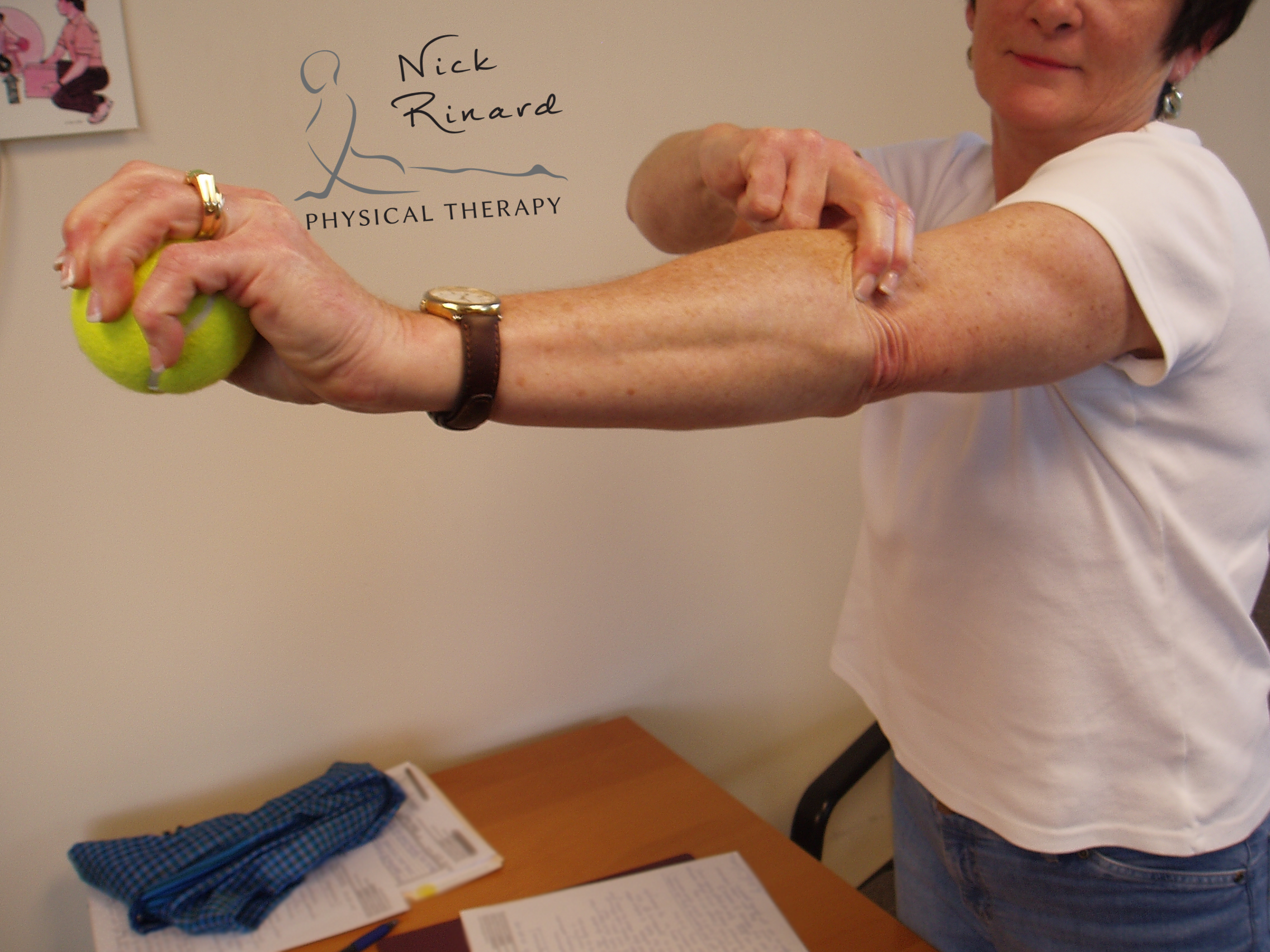 Objective findings included pain with passive elbow flexion and extension as well as pain with active wrist extension and with gripping a tennis ball. Because of my experience as a mechanical therapist, I am familiar with a technique called a mobilization with movement (MWM), developed by Brian Mulligan (a colleague of Robin McKenzie). The mobilization provides a lateral force over the ulna at the elbow joint. While the patient applied this force, he was able to grip the tennis ball PAIN FREE! This same technique was applied for other painful baselines and achieved the same results of ABOLITION OF ALL PAIN! These findings supported the therapist’s classification of elbow derangement, and MWM was selected as the treatment strategy.
The patient was asked to perform the MWM utilizing the lateral glide while gripping a tennis ball to be performed 10-20 times every hour. One proposed explanation is that mobilization changes joint positioning and mechanics. This is a theory, not an established explanation for this patient’s response; symptom improvement does not by itself prove that the joint was repositioned. The patient returned to the clinic the next day with reports of at least 25% improvement! Objective findings were retested and nearly all baselines had improved in less than 24 hours! The patient returned 1 week later and reported an 85% overall improvement with symptoms.
Don’t be misdiagnosed! Straightforward pathologies which require one exercise to treat are commonly missed with standard treatment. This results in extra physical therapy visits, and more of your time and money. It is worth your time to see if your pain has a MECHANICAL component, otherwise a simple solution may otherwise be missed.
Elbow pain care in Southwest Portland
For an assessment of your own symptoms, explore our physical therapy and mechanical assessment or hand and upper-extremity therapy services. Our office can help you choose the next step. Ask a question or request an evaluation, or call 503-244-6232. This archived case describes one person’s experience; individual results vary.