Hi everyone,
We hope you’re enjoying the last stretch of summer!
Just a quick reminder that Nick Rinard Physical Therapy will be closed on Monday, September 7th for Labor Day.
We’ll resume our normal schedule on Tuesday, September 8th.
We hope you have a safe and enjoyable Labor Day weekend!
Warmly,
Nick Rinard Physical Therapy Team
More
By Erick Severo
18 Aug, 2026
Clinic Announcements
exercise, insurance, MDT, Motor Vehicle Accident, MVA, Nick Rinard, Nick Rinard physical therapy, pain, pain-free, Physical Therapy, Portland Oregon, results, treatment
A car accident can happen in seconds, but the soreness, stiffness, headaches, and difficulty moving that follow can linger much longer.
One of the tricky things about motor vehicle accidents is that pain doesn’t always show up immediately. Adrenaline and stress can mask symptoms initially, and it’s common to notice increased neck pain, back pain, headaches, stiffness, or difficulty with everyday activities in the hours or days following an accident.
At Nick Rinard Physical Therapy, we help patients recover after motor vehicle accidents and get back to moving, working, exercising, and living with confidence.
Common Problems After a Car Accident
Even relatively low-speed accidents can place significant stress on the body. Some of the most common symptoms we see include:
- Neck pain and stiffness
- Whiplash-related symptoms
- Low or mid-back pain
- Headaches
- Shoulder pain
- Difficulty turning your head while driving
- Pain with sitting or sleeping
- Muscle tightness and soreness
- Reduced mobility
- Difficulty returning to work, exercise, or normal activities
These symptoms can look different for every person, which is why your treatment shouldn’t be one-size-fits-all.
How Physical Therapy Can Help
Your first visit starts with a thorough evaluation to understand how your symptoms respond to movement, what may be contributing to your pain, and which movements help you feel and move better.
From there, we develop an individualized treatment plan that may include hands-on treatment, specific exercises, mobility work, strengthening, and education to help you manage your symptoms between visits.
Our goal isn’t simply to make you feel better temporarily. We want to help you regain your normal movement and function while giving you the tools to continue progressing on your own.
Don’t Wait for Pain to Become Your “New Normal”
After an accident, it can be tempting to assume the soreness will eventually disappear on its own. Sometimes it does but if pain, stiffness, headaches, or difficulty with normal activities are sticking around, having the problem evaluated can help you understand what’s happening and what you can do about it.
Whether your accident happened recently or you’ve been dealing with symptoms for a while, we’re happy to help determine the next step.
Injured in a Motor Vehicle Accident?
Nick Rinard Physical Therapy is accepting patients following motor vehicle accidents.
If you have questions about starting physical therapy, scheduling an evaluation, or using your auto insurance benefits for treatment, give our office a call. Our team can help you navigate the process and determine your next steps.
Call Nick Rinard Physical Therapy at (503) 244-6232 or email at help@rinardpt.com to schedule an evaluation.
Already know someone who was recently in an accident? Feel free to forward this message to them – we’d be happy to help.
More
By Erick Severo
20 Jul, 2026
Clinical Case of the Week
exercise, hip, knee, MDT, Nick Rinard, Nick Rinard physical therapy, pain, pain-free, Physical Therapy, Portland Oregon, post-op, prehab, rehab, results, shoulder, Surgery, treatment
This article was written by Danya Sadler, Student Physical Therapist, during her clinical rotation at Nick Rinard Physical Therapy.
What is Prehab?
Many people assume that physical therapy begins only after surgery, but postoperative rehabilitation is just one part of what physical therapists do. The American College of Surgeons defines prehabilitation, or “prehab,” as “a process of improving the functional capability of a patient prior to a surgical procedure so the patient can withstand postoperative inactivity and the associated decline.” Physical therapists accomplish this through targeted exercise, education, and movement strategies tailored to each individual.
What the Research Shows
Prehab is much more than simply “getting ready” for surgery, it gives patients the opportunity to improve strength, mobility, and confidence while working toward their best possible outcome. A growing body of research has shown that prehab is an effective way to make the most of that opportunity. A research article by Konnyu, et al. finds that prehab prior to total knee or total hip surgeries can lead to reduced length of stay in the hospital, increased strength, and decreased stiffness post-operatively. Another article looking at orthopedic surgeries found that “prehabilitation was associated with moderate improvement in several preoperative outcomes (function, 6-minute walk test, knee flexor and hip abductor strength, etc.) among patients undergoing all orthopedic procedures and was also associated with a reduction in back pain among patients undergoing lumbar surgery.” (Punnoose et al., 2023). The research behind this topic has been vastly growing over the years but all other articles shared similar findings. In some cases, the prehab process reveals something patients weren’t expecting: surgery may not be the right next step after all.
When Physical Therapy May Help Avoid Surgery
For many musculoskeletal conditions, current evidence supports physical therapy as a first-line treatment for many musculoskeletal conditions before considering surgery, as many patients achieve similar improvements in pain and function without an operation. This is not to say that surgeries are bad nor never warranted, because they are actually very well researched and helpful in many cases. By using physical therapy first however can help patients find a potential non-surgical way of improving function and reducing pain, or, if symptoms persist despite appropriate rehabilitation, physical therapy can help patients and their healthcare team determine that surgery is the most appropriate next step. Multiple randomized control trials and systemic reviews comparing supervised exercise therapy with arthroscopic surgery for degenerative meniscal tears have found similar improvements in pain and function, while the physical therapy group demonstrated greater improvements in muscle strength early in rehabilitation.
A Closer Look at Low Back Pain
Evidence supporting conservative care extends beyond meniscal injuries. Similar recommendations exist for conditions such as knee osteoarthritis, rotator cuff injuries, and more but I want to present some evidence about its use with patients with low back pain since we see many individuals with this at the clinic. While surgery for back pain is appropriate in certain conditions like progressive neurological deficits or required fusions, most episodes of low back pain improve with conservative care. Current clinical practice guidelines from JOSPT and the American College of Physicians recommend remaining active, participating in exercise-based rehab, and working with a physical therapist before considering surgical intervention when there are no red flags found by your clinician or your physical therapist. Physical therapy can decrease pain, improve mobility, increase strength, and also help patients return to their daily activities while determining whether surgery is truly necessary.
The Right Treatment at the Right Time
Ultimately, the goal of prehab isn’t to avoid surgery at all costs, it is to ensure that each patient receives the right treatment at the right time whether it be surgery on conservative care. If surgery is found to be the best next step, patients will benefit from becoming stronger, more informed, and more active participants in their own care.
Citations
American College of Surgeons. (n.d.). Prehabilitation. Strong for Surgery. Retrieved July 8, 2026, from https://www.facs.org/for-patients/preparing-for-surgery/strong-for-surgery/prehabilitation/
Konnyu KJ, Thoma LM, Cao W, Aaron RK, Panagiotou OA, Bhuma MR, Adam GP, Pinto D, Balk EM. Prehabilitation for Total Knee or Total Hip Arthroplasty: A Systematic Review. Am J Phys Med Rehabil. 2023 Jan 1;102(1):1-10. doi: 10.1097/PHM.0000000000002006. Epub 2022 Mar 12. PMID: 35302954; PMCID: PMC9464791.
Punnoose A, Claydon-Mueller LS, Weiss O, Zhang J, Rushton A, Khanduja V. Prehabilitation for Patients Undergoing Orthopedic Surgery: A Systematic Review and Meta-analysis. JAMA Netw Open. 2023;6(4). doi:10.1001/jamanetworkopen.2023.8050
Kise N J, Risberg M A, Stensrud S, Ranstam J, Engebretsen L, Roos E M et al. Exercise therapy versus arthroscopic partial meniscectomy for degenerative meniscal tear in middle aged patients: randomised controlled trial with two year follow-up BMJ 2016; 354 doi:10.1136/bmj.i3740
Qaseem A, et al. Noninvasive Treatments for Acute, Subacute, and Chronic Low Back Pain: A Clinical Practice Guideline from the American College of Physicians. Annals of Internal Medicine. 2017;166(7):514–530.
George, S. Z., Fritz, J. M., Silfies, S. P., Schneider, M. J., Beneciuk, J. M., Lentz, T. A., Gilliam, J. R., Hendren, S., Norman, K. S., et al. (2021). Interventions for the management of acute and chronic low back pain: Revision 2021. Journal of Orthopaedic & Sports Physical Therapy, 51(11), CPG1–CPG60. https://doi.org/10.2519/jospt.2021.0304
More
This article was written by Danya Sadler, Student Physical Therapist, during her clinical rotation at Nick Rinard Physical Therapy.
When I first started my clinical rotation, I had no clue what MDT stood for or entailed. As I have learned this method and been able to apply its concepts to many patients over the weeks I’ve been here, I can see just how valuable this method is and have seen the effectiveness of it.
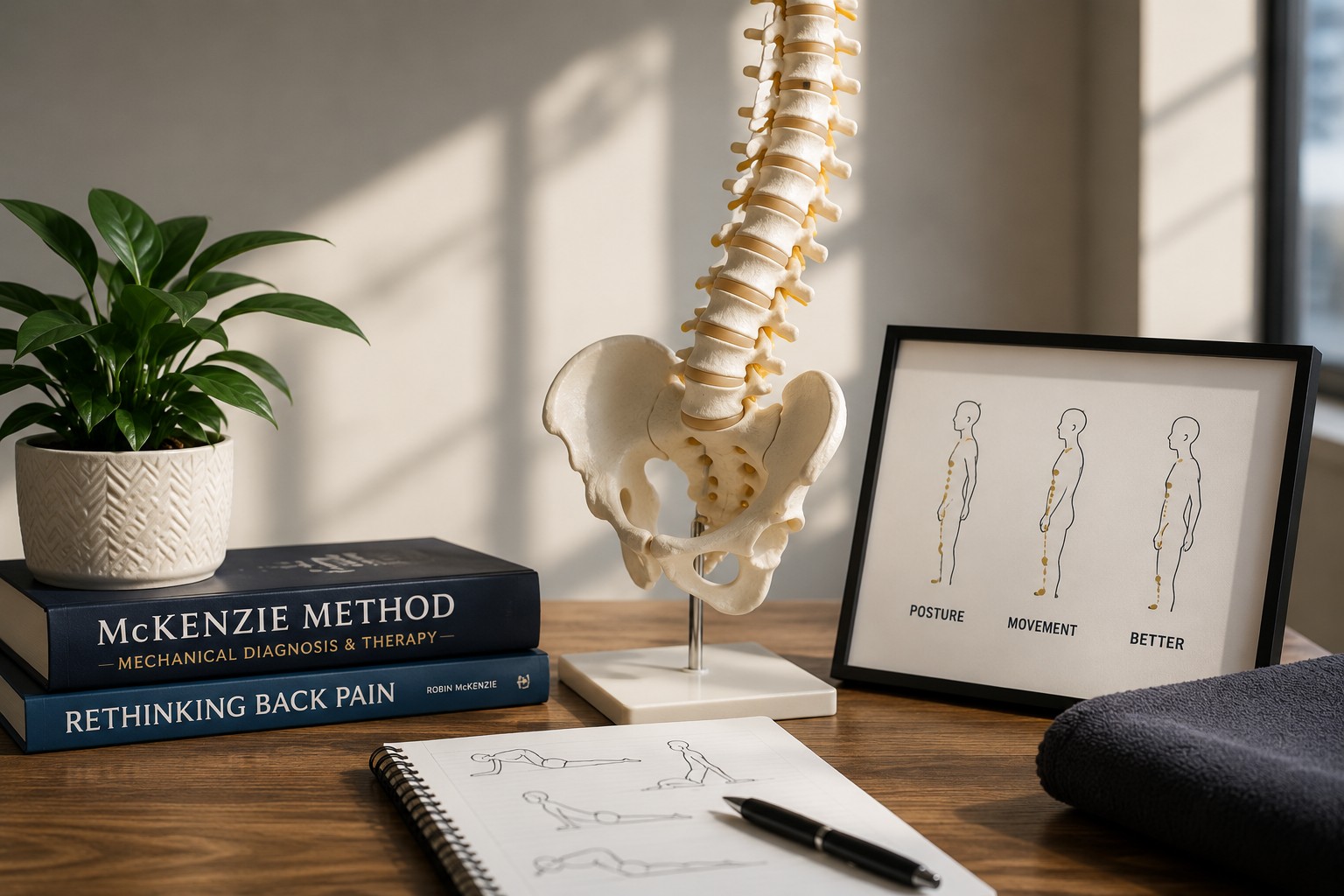
MDT stands for “Mechanical Diagnosis Therapy” and can also be known as “The McKenzie Method”. The National Library of Medicine defines MDT as “a classification system for assessing and treating various musculoskeletal conditions, including lower back, neck, and extremity pain.” This method works by dividing patients into different groups by presentation of symptoms and response to repeated testing. These include Derangement, Dysfunction, Postural, Chemical, or Other. Instead of focusing only on where it hurts, MDT clinicians look for patterns to identify which movements help your pain improve and which make it worse. Once those patterns are found, specific exercises are used and advice is given to help reduce your pain and improve your movement. One of the main goals of MDT is to teach you how to manage your symptoms yourself. We can help you identify the movements that improve your pain, and you’ll use those exercises at home so you’re not relying solely on treatment in the clinic.
What to Expect During an MDT Assessment
During an MDT assessment, the physical therapist asks detailed questions about the patient’s symptoms and how they change. They will assess your posture, range of motion, and resisted strength to determine deficits and/or pain throughout. The clinician will then guide the patient through repeated or sustained movements to observe how the patient’s symptoms respond. This is what the physical therapist uses to determine the MDT category and treatment approach. Treatment is tailored to each patient and may include stretching, posture correction, or unloading/resting the involved area.
Why MDT Works
Research has shown that MDT is an effective treatment option for many people with back or extremity pain, especially when it is provided by a clinician trained in the full MDT assessment process. MDT offers the added advantage of allowing treatment to be individualized while encouraging greater self-management compared to many other interventions. Current clinical guidelines also recommend education, exercise, and active self-management, all of which closely align with the MDT approach.
At Nick Rinard Physical Therapy, this assessment process is used to help us understand how your individual body responds to movement rather than applying the same treatment for everyone.
Our goal is to reduce pain, improve function, and provide you with the knowledge and tools to confidently manage your symptoms independently.
More
This case study was written by Danya Sadler, Student Physical Therapist, during her clinical rotation at Nick Rinard Physical Therapy. Names and identifying details have been modified to protect patient privacy.
When Shoulder Pain Isn’t What It Seems
During my first week at the clinic, we had a patient come in with intense shoulder and neck pain with occasional extreme headaches and a tingling sensation down the arm. They even had an episode that sent them to the ER. When they came in, they were 60–70% functionally limited in activities like sleeping, looking down, and turning to the left. This patient also had a lot of limitations with their range of motion which made it hard to complete everyday tasks like reaching to a shelf.
When they came into Nick Rinard Physical Therapy, we tested their range of motion and resisted strength and found something interesting. This patient demonstrated limitations in both active and passive range of motion, yet their resisted strength remained intact. Based on these findings, adhesive capsulitis (frozen shoulder) became our leading hypothesis.
The Test That Changed Everything
One of the biggest mistakes in healthcare is stopping your assessment once something seems to fit. Good clinicians continue testing to make sure the diagnosis truly holds up. The patient performed a repeated passive shoulder extension movement which, if this was truly frozen shoulder, would not be expected to change their range of motion. To our surprise, range of motion improved by 10°, disproving the frozen shoulder hypothesis.
A Better Answer, Better Results
Over subsequent visits, we continued addressing the range of motion deficits, functional limitations, headaches, and arm tingling. Within five appointments, the patient reported no arm tingling, fewer headaches, improved range of motion, better functionality, and generally feeling much better.
Why the Right Assessment Matters
A key takeaway from this case is that symptoms can sometimes mimic a more serious or long-term condition, but the right assessment can uncover a more treatable cause.
If this sounds familiar—whether in your shoulder, back, or elsewhere—a thorough movement assessment may help identify what’s really driving your symptoms.
More
By Erick Severo
16 Jun, 2026
Clinical Case of the Week
exercise, MDT, Nick Rinard, Nick Rinard physical therapy, pain, pain-free, Physical Therapy, Portland Oregon, results, treatment
Written by: Danya Sadler, SPT
When Rib Pain Isn’t What It Seems
We had a patient this past week with a unique challenge. This patient had been fighting with a serious medical condition for the past couple months and had, a week before seeing us, started experiencing pain on their left lower ribs. This patient had great difficulty sleeping, rolling over, and generally moving around and wanted to see if this new symptom was related to the illness or if it had a mechanical component.
This visit was conducted via telehealth which is a great way for patients to be seen who either are living or travelling far away or people, like our patient in this article, who are homebound due to their illness or injury. This patient was told at the start of the visit that we were going to use this first visit to determine if there was a mechanical component to their rib pain and if there wasn’t, that we were going to help guide them to appropriate medical providers for further evaluation.
Using Movement to Find Answers
During this visit, it was difficult to conclude whether the rib pain was mechanical or visceral. The patient had tenderness around their left lower ribs, but also had right sided tenderness right underneath the ribs dealing more with internal structures. One notable finding was the patient experienced some pain relief when side-gliding to the right and side-bending to the right. Based on this response, we decided to have the patient perform these consistently over the next few days to see if this would relieve symptoms and help us conclude if this rib pain was indeed mechanically based.
An Unexpected Setback—and a Breakthrough
When we followed up with the patient a few days later, they reported an eventful week. Shortly after our initial evaluation, they went to the emergency room with severe rib pain and did not do their PT exercises at all. After testing negative for any illness related cause of her rib pain, she went home and then began performing the assigned movements consistently. They worked! The patient was happy to report that their pain had almost completely gone away! They were very grateful that we were able to provide the tools to reduce their pain and gave them hope even in these really difficult times that they were facing with their illness.
The Power of a Thorough Assessment
This case highlights the value of a thorough physical therapy evaluation, even when symptoms occur alongside a significant medical condition. Rather than making assumptions about the source of the patient’s pain, we used movement testing and symptom response to guide our clinical decision-making and determine the most appropriate next steps. By the patient’s second visit, their rib pain had improved dramatically, allowing them to move, sleep, and function more comfortably. Just as importantly, the patient gained confidence and clarity during a challenging time in their health journey.
More