This article was written by Danya Sadler, Student Physical Therapist, during her clinical rotation at Nick Rinard Physical Therapy.
When I first started my clinical rotation, I had no clue what MDT stood for or entailed. As I have learned this method and been able to apply its concepts to many patients over the weeks I’ve been here, I can see just how valuable this method is and have seen the effectiveness of it.
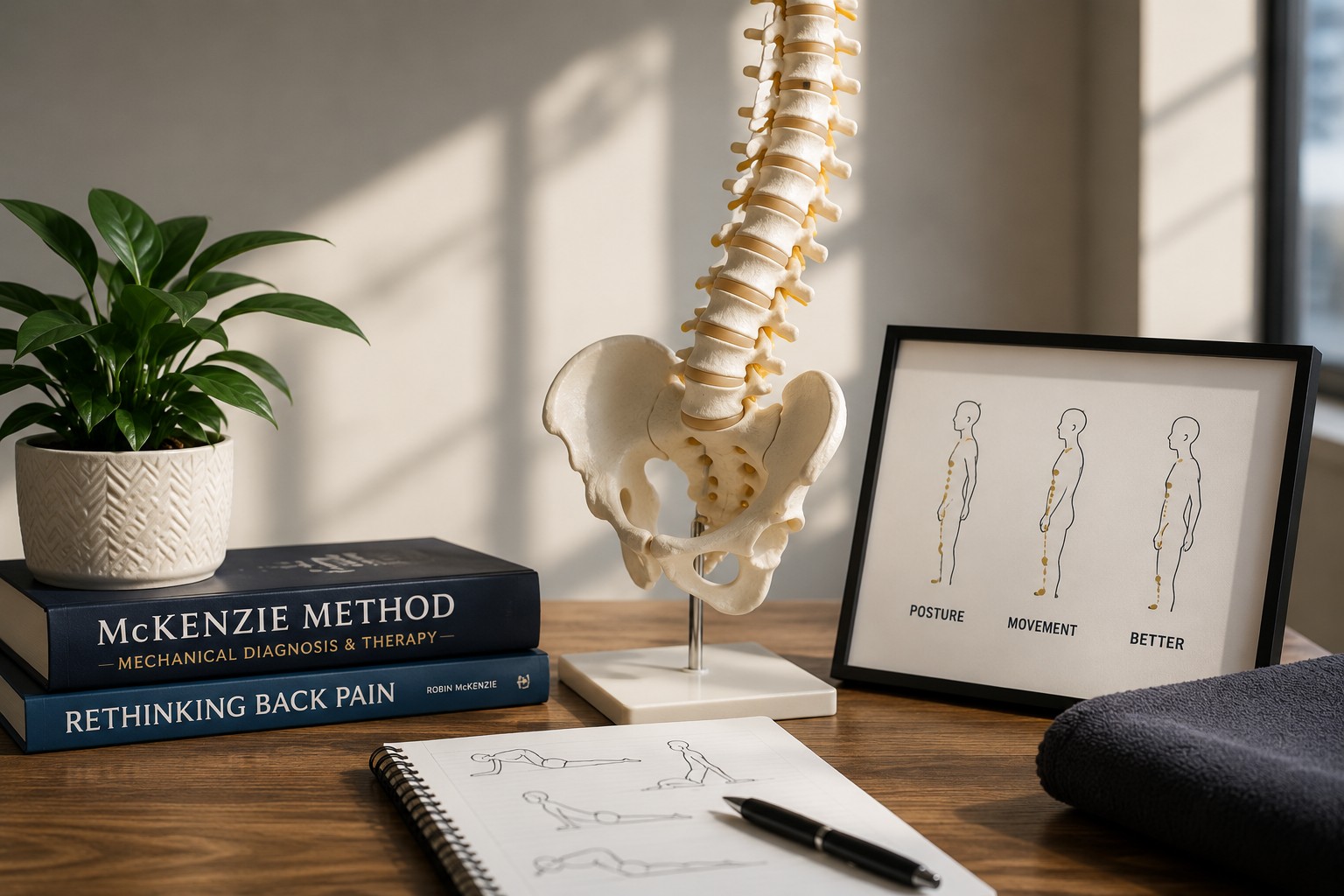
MDT stands for “Mechanical Diagnosis Therapy” and can also be known as “The McKenzie Method”. The National Library of Medicine defines MDT as “a classification system for assessing and treating various musculoskeletal conditions, including lower back, neck, and extremity pain.” This method works by dividing patients into different groups by presentation of symptoms and response to repeated testing. These include Derangement, Dysfunction, Postural, Chemical, or Other. Instead of focusing only on where it hurts, MDT clinicians look for patterns to identify which movements help your pain improve and which make it worse. Once those patterns are found, specific exercises are used and advice is given to help reduce your pain and improve your movement. One of the main goals of MDT is to teach you how to manage your symptoms yourself. We can help you identify the movements that improve your pain, and you’ll use those exercises at home so you’re not relying solely on treatment in the clinic.
What to Expect During an MDT Assessment
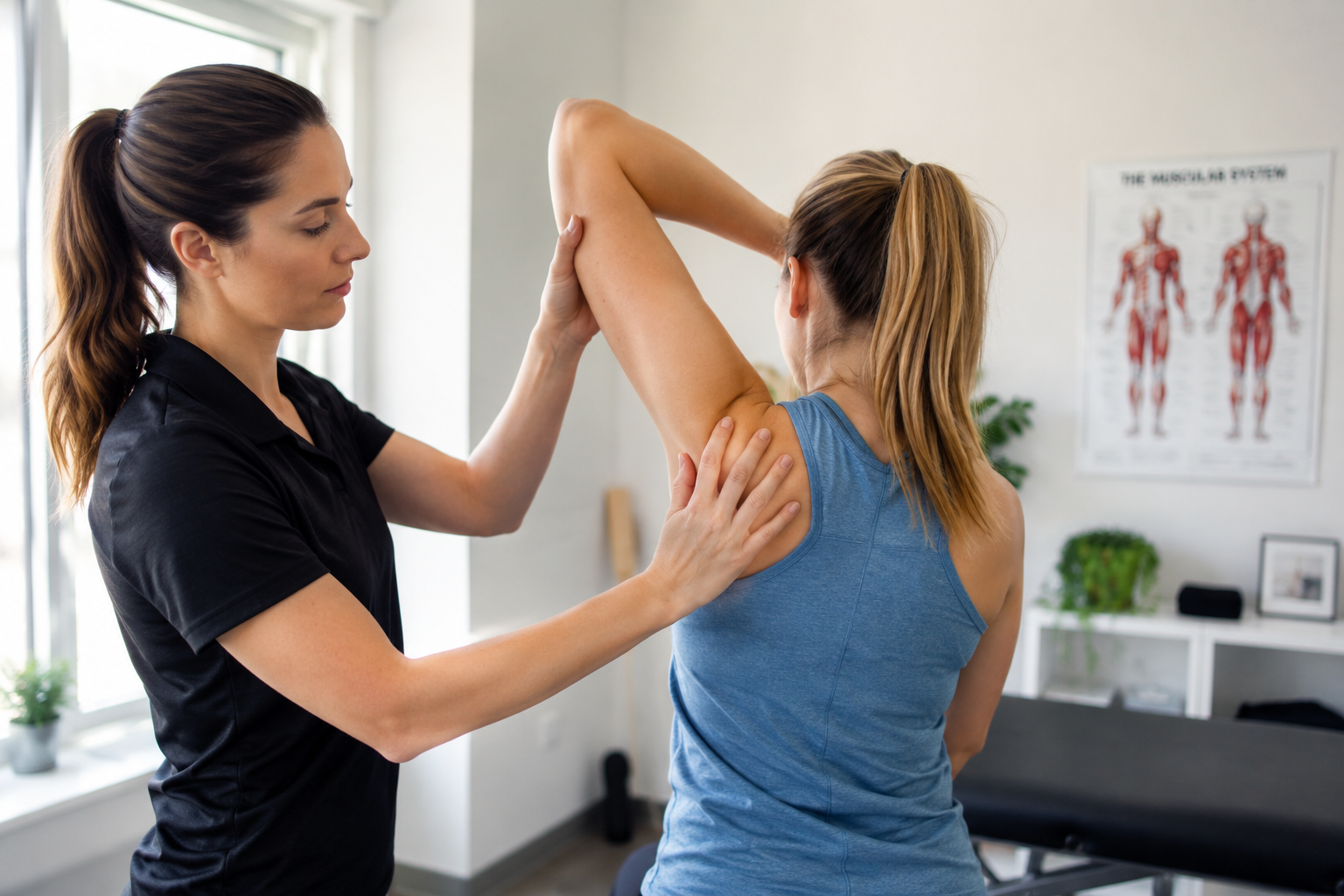
During an MDT assessment, the physical therapist asks detailed questions about the patient’s symptoms and how they change. They will assess your posture, range of motion, and resisted strength to determine deficits and/or pain throughout. The clinician will then guide the patient through repeated or sustained movements to observe how the patient’s symptoms respond. This is what the physical therapist uses to determine the MDT category and treatment approach. Treatment is tailored to each patient and may include stretching, posture correction, or unloading/resting the involved area.
Why MDT Works
Research has shown that MDT is an effective treatment option for many people with back or extremity pain, especially when it is provided by a clinician trained in the full MDT assessment process. MDT offers the added advantage of allowing treatment to be individualized while encouraging greater self-management compared to many other interventions. Current clinical guidelines also recommend education, exercise, and active self-management, all of which closely align with the MDT approach.
At Nick Rinard Physical Therapy, this assessment process is used to help us understand how your individual body responds to movement rather than applying the same treatment for everyone.
Our goal is to reduce pain, improve function, and provide you with the knowledge and tools to confidently manage your symptoms independently.
More
This case study was written by Danya Sadler, Student Physical Therapist, during her clinical rotation at Nick Rinard Physical Therapy. Names and identifying details have been modified to protect patient privacy.
When Shoulder Pain Isn’t What It Seems
During my first week at the clinic, we had a patient come in with intense shoulder and neck pain with occasional extreme headaches and a tingling sensation down the arm. They even had an episode that sent them to the ER. When they came in, they were 60–70% functionally limited in activities like sleeping, looking down, and turning to the left. This patient also had a lot of limitations with their range of motion which made it hard to complete everyday tasks like reaching to a shelf.
When they came into Nick Rinard Physical Therapy, we tested their range of motion and resisted strength and found something interesting. This patient demonstrated limitations in both active and passive range of motion, yet their resisted strength remained intact. Based on these findings, adhesive capsulitis (frozen shoulder) became our leading hypothesis.
The Test That Changed Everything
One of the biggest mistakes in healthcare is stopping your assessment once something seems to fit. Good clinicians continue testing to make sure the diagnosis truly holds up. The patient performed a repeated passive shoulder extension movement which, if this was truly frozen shoulder, would not be expected to change their range of motion. To our surprise, range of motion improved by 10°, disproving the frozen shoulder hypothesis.
A Better Answer, Better Results
Over subsequent visits, we continued addressing the range of motion deficits, functional limitations, headaches, and arm tingling. Within five appointments, the patient reported no arm tingling, fewer headaches, improved range of motion, better functionality, and generally feeling much better.
Why the Right Assessment Matters
A key takeaway from this case is that symptoms can sometimes mimic a more serious or long-term condition, but the right assessment can uncover a more treatable cause.
If this sounds familiar—whether in your shoulder, back, or elsewhere—a thorough movement assessment may help identify what’s really driving your symptoms.
More
“I came to Nick Rinard with back and leg pain that not being addressed by my current healthcare provider (because the current provider had no openings for PT).
I chose Nick Rinard because I had had a good experience there for an unrelated problem in the past.
Nick discussed my problems, possible PT options, “fixes,” & a strategy for exploring the options.
We tried a couple of alternatives & settled on a path.
I am happy with the results especially the pain reductions.
I felt Nick wasn’t me to have a positive outcome & kept me fully informed regarding why we were doing what we were doing, what he expected & importantly when he thought we had made all the progress we would make.
I am very happy that I came & would certainly do it again.
PS I paid for the treatments myself & regard it as money very well spent.”
James
More
The case study I would like to share with you today is only the second hip derangement of this type that I have seen. “Jim” was a 55 year old male who presented with right hip pain that started for no apparent reason 5-6 months prior to coming to physical therapy. He said the pain was provoked only when he was walking, but it occurred consistently at a distance of about 50 to 100 yards. Often it was so painful he could not continue walking. Jim figured out that changing his right foot position enabled him to walk a little further, albeit slowly, and then he could resume normal walking for another 50 yards or so. He would change the foot position by stepping partway onto a curb or raised ground such that the outer edge of his foot was tilted up (eversion, as we therapists call it), and then he would angle his right knee inwardly. That was the only way he had found to improve walking, but the hip just would not stay better.
In desperation, Jim said he had looked online and tried numerous “hip exercises” without any relief. He consulted his doctor, who recommended MDT, which we do here at Nick Rinard Physical Therapy.
Assessment
The mechanical assessment was positive for only two findings: limited and painful hip motion into flexion (folding the knee to chest), and weak and painful testing of hamstring resistance. The protocol for ruling out a joint derangement is to repeat motions to determine if the baselines change. The question is which motion to repeat. One can move either into the most painful direction, go the opposite direction, or check rotations. I chose to go into the most painful direction, in this case, flexion. But before testing I wanted to establish how far Jim could walk in the clinic before his pain started. By the time he walked one length of the hallway and back, he reported pain. I then instructed Jim to bend his knee to chest (compressing the groin) repeatedly and after 20 to 30 times. It produced his familiar pain initially, then the pain abolished and his motion increased. I tested walking after that and Jim said there was no pain even after walking 3 lengths up and back through the hallway! I gave Jim his exercises and scheduled him for 2 days later.
Progress
When Jim returned he reported that he could walk longer distances without the pain starting, however, he still got to the point where he had to modify his foot position in order to continue. I knew we were on the right track, and the next step in treating a joint derangement is to progress forces. I did this manually by applying over-pressure, and instructed Jim to do it in standing by folding his chest down to his knee with it supported on a bench or chair. By the next visit, Jim reported that this had worked very well and he had not experienced any pain at all! So, the derangement was reduced and I needed to wean him off the home exercises to see if it would return or not. I gave him the weaning program and asked to see him back in 2 weeks.
Pain Free
After 2 weeks, Jim came back reporting that he had been able to walk unlimited distances! He resumed walking his dog, going on walks for exercise, and walking wherever, and whenever he wanted. He reported his longest walk lasted 4.5 hours. He said there was no return of the original hip pain from which he had suffered for months. However, on his last two walks, he had started noticing a new hip pain, this time in the front, not on the sides. I re-checked his baselines and neither flexion motion nor resisted hamstrings were painful. That meant it could not be a re-derangement. Resisted hip flexion was painful, and that was new. I concluded that his sudden ability to walk pain-free resulted in his over-doing it. Jim had increased walking too fast and gotten a minor tendonitis. That was easy to treat, and by his next visit, Jim was pain-free again and able to progress walking, though this time more gradually, which was safer.
Successful Treatment
Jim’s hip treatment was obviously a success. It took only 4 visits. This hip derangement was unique because the direction that reduced it (flexion); I have only seen one other hip derangement require flexion to reduce it. The fact that Jim resumed normal activity too fast is typical of reduced derangements – the patient feels so good that they over do it. Luckily in Jim’s case, we found the new problem and fixed it just as fast as we found and fixed his chronic hip pain.
More
“While climbing at Smith Rock, I broke my ankle and needed surgery in June.
I first came into this office on crutches, worried I’d never climb again.
In about 6 months, Katie had me back on my feet and back on the climbing wall.
Not only was I given the support I needed to get back to my day-to-day life, but I learned so much about my body and its needs that I didn’t know before.
It has made me a more successful athlete, and better attuned to what my body needs on a given day.
The whole office treated me so kindly throughout this whole experience, and Katie in particular was incredibly compassionate to the mental and emotional impacts of my injury.
(Thank you so much!)”
Ali
More
Winter is just around the corner and the coronavirus still lingers in our community. It is hard to remember that just last winter many of us were still waiting to get vaccinated, and now all of our employees are vaccinated and for those eligible, they have received their booster shot.
Our clinic has remained open and available because our team has always but still continue to follow all guidance recommended by the state.
All employees at Nick Rinard Physical Therapy continue to put the safety of our patients first!
As a reminder…
New patients and established patients will find every visit very valuable and should not delay care due to increases in Coronavirus cases.
We are here to diagnose, educate, offer tools, listen to concerns, and meet all safety needs to get patients through this difficult time.
Nick Rinard Physical Therapy loves treating patients and happy to keep not only our doors open but also our hands and hearts to get everyone the results you have come to know and trust for the last 20 years.
More
“I was dealing with continuous neck pain which was bring on headaches.
The discomfort came to a point where I needed help with correcting the problem.
The right side of my neck was very sore, limiting full movement to the left.
Nick Rinard’s team helped me find easy and incredibly helpful stretches to correct my posture and alleviate the pain.
After 4 appointments I am able to rotate my head left and right without any tension of discomfort.
The neck pain and headaches are currently gone.Wahoo! Thank NRPT team!”
Allison
More
Hello! Melissa and Madeline here, and for those who we have not yet had the opportunity to meet, we are the two physical therapy residents working with Nick and Katie this summer.
We are from the University of Wisconsin-La Crosse where we are in our third and final year of the Doctorate of Physical Therapy program.
This has been the first of our three clinical internships, and we could not have been luckier in our first placement!
Working at Nick Rinard Physical Therapy this summer has been a great opportunity for the two of us to improve our clinical skills and grow as clinicians.
We are lucky to have two incredible mentors (Nick and Katie) to follow and learn from every day.
Nick and Katie have so much knowledge to share and go above and beyond in treating their patients.
Likewise, we are lucky to have such wonderful patients who allow us to work with and learn from them as well.
We look forward to the last couple of weeks we will be working at the clinic before heading back home to the Midwest to finish up the last of our schooling.
Both of us are very grateful for this experience!
~Madeline & Melissa
More
Osteoporosis is the leading cause of fractures resulting in billions of dollars being spent in the healthcare system. As a physical therapist, it is important to educate the public on information for reducing the risk of fracture, which is a frequent and possibly serious co-morbidity of osteoporosis. The public is subjected to multiple commercials advertising medications that can help fight osteoporosis. What they may not know, is that simple exercise alone can improve your bone density, decrease your risk of fractures and doesn’t come attached to a list of adverse side effects.
Facts:
- Osteoporosis is a bone disease that leads to decreased mineral content and bone density, resulting in a weakening of the bone
- The incidence of this disease has been shown to increase with older age
- Worldwide, 50% of women over the age of 60 will have an osteoporotic fracture, an incidence rate that is larger than the combined incident rates of heart attack, stroke, and breast cancer.
- One study from 1992 had a worldwide projection that osteoporotic fractures would affect one-third of all men during their lifetime by the year 2050.
- Primary risk factors for osteoporotic fractures include low bone mineral density, deterioration of bone, older age, Caucasian race, female sex, lower body weight and AN INACTIVE LIFESTYLE.

What can you do?
- Exercise can decrease the risk of an osteoporosis related fracture by 50%
- One study found that weight bearing exercise for 20 minutes a day can positively affect risk factors associated with osteoporotic fractures among elderly women. The exercises for the intervention group included: jumping, dancing, walking, strengthening, and balance exercises. The exercise group had increased leg strength as well as improvement in walking speed and endurance, as compared to the control group. In a long-term follow-up study, the same authors found that the above intervention decreased mortality in women with osteopenia (a precursor to Osteoporosis).
- A bi-weekly exercise routine developed by your PT can increase your bone density.
- Muscle contraction and mechanical loading deform bone and stimulate activity of osteoblasts, the cells which build bone. It is, therefore, not surprising that these interventions improve bone mineral density.
Want to learn more?
More
“I first came here due to a ruptured disc with sever pain and felt immediate relief.
I believe these experts are the most talented people I’ve ever met with their medicine and diagnosis therapy. *
When I came in—at first– I was very limited. I could not work or function normally. Now I can do everything.”
~ Terry
More