Nick Rinard Physical Therapy can treat your herniated disk TODAY!
Don’t get scared over a herniated disk.
Nick Rinard Physical Therapy can help!
“A herniated disk and all the symptoms.
Hip socket-
Pain has gone away- mobility is back.”
Mark
 (formerly Mechanical Diagnosis and Therapy of Portland, PC)
Don’t get scared over a herniated disk.
Nick Rinard Physical Therapy can help!
“A herniated disk and all the symptoms.
Hip socket-
Pain has gone away- mobility is back.”
Mark
Do you have friends and family complaining of aches and pains?
Send them to Nick Rinard Physical Therapy!
We are here to help!
Send folks to us for a Free Screen or full evaluation.
They will thank you for helping them find relief, and we will thank you for letting us help them be free of pain in just 6-8 visits!
MoreGet your sleep back by calling and scheduling your evaluation at Nick Rinard Physical Therapy today.
“I was not able to walk my usual 2 miles a day and I was having pain all day and night in the thigh.
Because I could not massage it out, I figured it was a spinal referral pain.
Having been “fixed” by the McKenzie Method of lower back pain after a fall in 2014, I asked my provider for a referral here.
I can walk as much as I want now. I can sleep with no pain.”
Tenny
More“I was referred here by my doctor after other forms of PT had not helped.
I started seeing results immediately, which is unheard of based on my previous PT experiences.
Now I’m no longer in constant pain and feel well on my way to full functionality of my arm.”
Daniel
MoreLateral epicondylitis, more commonly known as “tennis elbow,” is a pathology that is familiar to physical therapists and the general public. What is lesser known is “pseudo tennis elbow,” a mechanical problem with a very simple solution! Unfortunately, therapists whom are not familiar with the utilization of mechanical diagnosis may unknowingly miss this common elbow derangement. As a therapist practicing the McKenzie method of mechanical diagnosis, I have diagnosed BOTH of my current elbow pain patients as derangements (or pseudo tennis elbow).
Portland area patient presented to physical therapy with intermittent right elbow pain, worsening over the last 3 months. Patient reported difficulty with gripping, lifting, carrying and global limited function of the right arm. Patient described symptoms as “variable” meaning he could perform a task that produced his elbow pain. Then, perform the same task or movement again without experiencing any pain at all! This variability of pain is the hallmark of a derangement and should not be misdiagnosed as a tendonitis (also called tendinitis), which would indicate inflammation (in which case pain would be constant). Patient rated worst elbow pain as a 6/10.
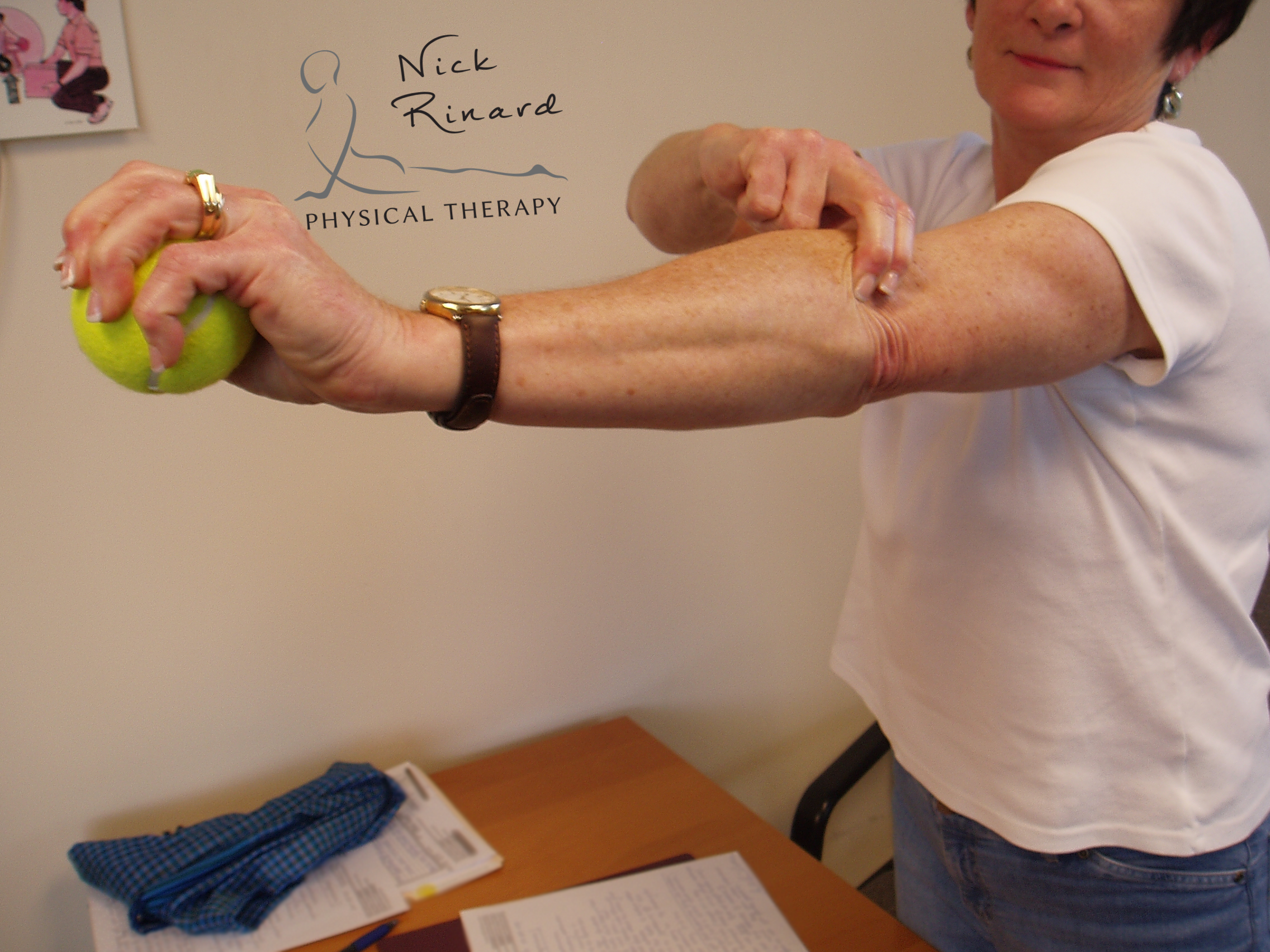 Objective findings included pain with passive elbow flexion and extension as well as pain with active wrist extension and with gripping a tennis ball. Because of my experience as a mechanical therapist, I am familiar with a technique called a mobilization with movement (MWM), developed by Brian Mulligan (a colleague of Robin McKenzie). The mobilization provides a lateral force over the ulna at the elbow joint. While the patient applied this force, he was able to grip the tennis ball PAIN FREE! This same technique was applied for other painful baselines and achieved the same results of ABOLITION OF ALL PAIN! This ability to turn symptoms off with a mobilization indicates an elbow derangement and the MWM is used as the treatment strategy.
The patient was asked to perform the MWM utilizing the lateral glide while gripping a tennis ball to be performed 10-20 times every hour. The theory is that this mobilization is re-positioning the joint in order for it to articulate correctly, resulting in improved range of motion and strength after. The patient returned to the clinic the next day with reports of at least 25% improvement! Objective findings were retested and nearly all baselines had improved in less than 24 hours! The patient returned 1 week later and reported an 85% overall improvement with symptoms.
Don’t be misdiagnosed! Straightforward pathologies which require one exercise to treat are commonly missed with standard treatment. This results in extra physical therapy visits, and more of your time and money. It is worth your time to see if your pain has a MECHANICAL component, otherwise a simple solution may otherwise be missed.
If you are experiencing elbow pain and are living in the Portland/Vancouver metro area, get the best results by calling us today at 503-244-6232 to schedule a physical therapy evaluation.
MoreBy MiKayla Sanocki, SPT
Did you know a back problem can cause symptoms such as pain, decreased strength and decreased sensations into the thigh, calf, ankle or foot? Physical therapists trained in Mechanical Diagnosis and Therapy (MDT) here at Nick Rinard Physical Therapy can determine during the evaluation if any of these lower leg symptoms are coming from your back.
Check out this bizarre clinical presentation we treated at Nick Rinard Physical Therapy:
The patient came to physical therapy for an “ankle sprain” that occurred 3-months earlier. She stated she woke up unable to put any weight on her right foot. The pain had remained constant in her ankle, so bad at times that she couldn’t walk! Upon further questioning, the patient revealed what she had been doing the day before: She had driven 2 hours, on her way home from helping clean a house. During the drive she had discomfort in her buttock and hamstring that made her want to pull the car over to stretch. She did not remember any trauma to the ankle, however, but the ankle pain was the only pain she was experiencing now.
Her ankle pain has caused her to quit running and yoga — two of her favorite activities.
 During the mechanical evaluation we found that certain directions of low back movements decreased the pain in her ankle. After being sent home with 1 simple exercise to perform every waking hour – which she did perfectly – she returned within 24 hours reporting 90% recovery in pain! Over the next week we were able to progress her exercises and now the patient reports no ankle pain at all. In only 4 visits we were able to abolish her ankle pain, and she is now getting back to running and yoga!
The patient reports, “I now have the tools to prevent the return of my back and ankle pain”.
In contrast to MDT, traditional PT would not have uncovered the spinal cause of the patient’s ankle pain. Treatment would have been ineffective since it would have focused only on trying to treat the symptom.
Do you know if your pain in the legs or arms could be coming from the spine? Come see us at Nick Rinard Physical Therapy and find out!
More