Last week we had a patient come in for severe knee pain. He played tennis four times in a row and had no problems with his knee. He then sat in a scrunched position and had knee pain when he got up. He went to his doctor and got a referral to an orthopedist. The orthopedist sent a referral for acute knee pain. The patient scheduled with Nick Rinard Physical Therapy – Mechanical Evaluation immediately diagnosed he was experiencing a spine injury, leading to referred symptoms in the knee.
So we want you to know:
A spine problem can cause symptoms such as pain, decreased strength and decreased sensations into the thigh, calf, ankle or foot. Physical therapists trained in Mechanical Diagnosis and Therapy (MDT) here at Nick Rinard Physical Therapy can determine during the evaluation if any of these lower leg symptoms are coming from your spine.
Her is another clinical presentation we treated at Nick Rinard Physical Therapy: By MiKayla Sanocki, SPT
She did not remember any trauma to the ankle
The patient came to physical therapy for an “ankle sprain” that occurred 3-months earlier. She stated she woke up unable to put any weight on her right foot. The pain had remained constant in her ankle, so bad at times that she couldn’t walk! Upon further questioning, the patient revealed what she had been doing the day before: She had driven 2 hours, on her way home from helping clean a house. During the drive she had discomfort in her buttock and hamstring that made her want to pull the car over to stretch. She did not remember any trauma to the ankle, however, but the ankle pain was the only pain she was experiencing now.
Her ankle pain has caused her to quit running and yoga — two of her favorite activities.
Mechanical Evaluation finds cause in spine
During the mechanical evaluation we found that certain directions of low back movements decreased the pain in her ankle. After being sent home with 1 simple exercise to perform every waking hour – which she did perfectly – she returned within 24 hours reporting 90% recovery in pain! Over the next week we were able to progress her exercises and now the patient reports no ankle pain at all. In only 4 visits we were able to abolish her ankle pain, and she is now getting back to running and yoga!
The patient reports, “I now have the tools to prevent the return of my back and ankle pain”.
Treatment at Nick Rinard Physical Therapy vs Traditional PT
In contrast to MDT, traditional PT would not have uncovered the spinal cause of the patient’s ankle pain. Treatment would have been ineffective since it would have focused only on trying to treat the symptom.
Do you know if your pain in the legs or arms could be coming from the spine? Schedule your evaluation at Nick Rinard Physical Therapy and find out!
“I came to Nick Rinard with back and leg pain that not being addressed by my current healthcare provider (because the current provider had no openings for PT).
I chose Nick Rinard because I had had a good experience there for an unrelated problem in the past.
Nick discussed my problems, possible PT options, “fixes,” & a strategy for exploring the options.
We tried a couple of alternatives & settled on a path.
I am happy with the results especially the pain reductions.
I felt Nick wasn’t me to have a positive outcome & kept me fully informed regarding why we were doing what we were doing, what he expected & importantly when he thought we had made all the progress we would make.
I am very happy that I came & would certainly do it again.
PS I paid for the treatments myself & regard it as money very well spent.”
Thank you Troy for sharing your Nick Rinard Physical Therapy experience on google.
“As a competitive weightlifter, the pain in my back was seriously stalling my training.
Nick really listened and understood my goals and my issues and helped me get rid of the pain I’d been dealing with for over 6 months with only 2 visits and some assigned stretches.
I couldn’t believe it!
I’d seen doctors and other PTs and was about to get an MRI so I could get cortisone shots which was going to take months and only mask the pain if it solved it at all.
Sometimes knee pain is actually a back problem! Nick Rinard Physical Therapy makes sure to get the correct diagnosis every time!
“I had continuing knee problems and had seen other physical therapists.
This felt like my last efforts to resolves issues if I could.
With Katie’s awesome attention and care, she weeded through my knee problems and determined it might be a back issue, based on one of our conversations.
Our plans switched to restoring my back and core.
As a result, knee issues decreased!! I am back to running longer distances with no knee issues!
I have the tools/exercises to continue strengthening!
(Teagan was also an amazing student intern – loved that Nick and Katie took her on and helped her hone her skills. She took everything on very well.)”
Nick Rinard Physical Therapy uses cutting-edge, scientifically-validated mechanical diagnosis and treatment techniques to help you find the cause and cure of your back pain. Let us help you today.
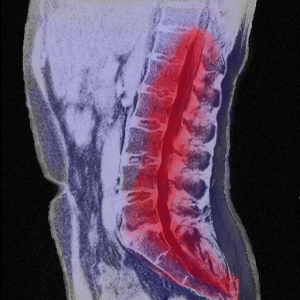
Many times we have patients who come for physical therapy treatment describing pain in their leg, but it turns out to be coming from their spine. This is often confusing for people, especially if they have been given a provisional medical diagnosis related to the area of pain, like “piriformis syndrome”, which is pain in one of your gluteal muscles. You may wonder how we determine where the pain is coming from and what to treat. Pain is produced by sensory nerves. Sensory nerves can be triggered locally at the spinally level, or peripherally either by muscle tension or injury. During the evaluation we always perform spine ROM to determine if the source could be coming from the spine. The screen must begin from the center outward. In some cases, knee/hip/ankle pain will decrease or increase during the lumbar spine screen, and then we know it is coming from the spine. This can be hard to understand for some patients because the pain they are experiencing feels like it is coming from that very spot, whether it is a joint or muscle, that is painful. For example, I recently evaluated a patient with ankle pain. She had even fallen, which made it possible she could have some trauma to her ankle from the fall. However, during the lumbar spine screen, her ankle pain decreased while performing a back bend. She was in disbelief that her ankle pain went away. After only a few visits her ankle pain was gone and it did not return. One of her lumbar discs was pressing on a nerve root and causing her ankle pain, and the back bending pushed the disc away from the nerve and abolished the pain. The moral of the story is, we can never assume a diagnosis until a thorough examination is performed.
The American Heart Association recommends at least 30 minutes of moderate-intensity aerobic activity at least 5 days/week. In the pursuit of good health and fitness, many people are using YouTube to access new workouts. Unfortunately, there is neither quality control nor an accreditation process to ensure that the workouts are sound. Further complicating things is the “no pain, no gain” exercise myth which leads people to expect suffering with exercise. If someone expects exercising to be painful, they may not heed the early warning signs of pain and become injured.
Recently, I treated a young woman who developed severe lower back pain after exercising with a popular fitness program online. She continued to push herself through the routines but after 2 weeks she quit exercising entirely. She was frustrated because her efforts to improve her health had actually worsened her condition. Her back pain was interrupting her sleep and limiting her ability to concentrate at work.
After just 4 sessions at Nick Rinard Physical Therapy she was pain free and equipped with an effective, individualized exercise program that supported her fitness goals without compromising her If your workout is wearing you down, we can help you get on the right track! Don’t settle for suffering through your exercise routine when you could be thriving.
LOW BACK PAIN—What you should do while waiting for your first physical therapy appointment…
SITTING:
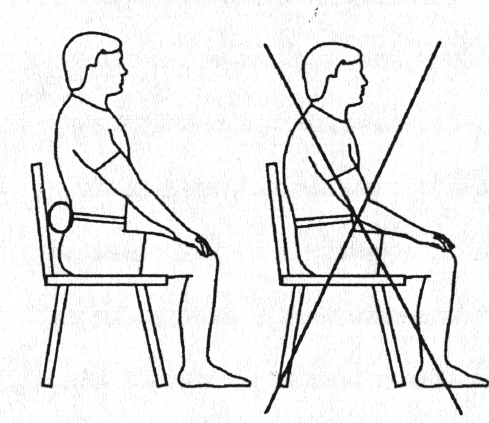
Sit as little as possible. Standing or lying down are preferable to sitting when in acute low back pain. If you must sit, sit only in a straight backed chair with good posture. Avoid couches or soft chairs. Use a towel roll to support the natural curve of your spine.
BENDING:
Do not bend forwards as in touching your toes when in acute low back pain—even if it feels like you are doing good by “stretching” the muscles of the low back. Rather than reaching down to get things, squat down using the legs and keep the back absolutely straight.
LYING:
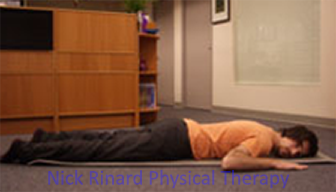
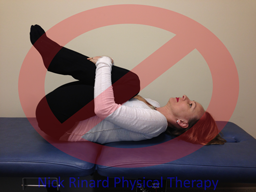
Try to lie more on your stomach rather than on your back. Avoid the temptation to lie on your back with the head and knees propped up—this just rounds the back more and places inappropriate stress on injured structures.
EXERCISES:
You should stay normally active–in other words try not to stay in bed for long periods. Move around, take walk if you can. Do not do the knees to chest exercise you may have learned before. This is an advanced exercise and usually not appropriate for acute conditions. It is better in most cases to lie on your stomach and work towards supporting yourself on the elbows.


 The American Heart Association recommends at least 30 minutes of moderate-intensity aerobic activity at least 5 days/week. In the pursuit of good health and fitness, many people are using YouTube to access new workouts. Unfortunately, there is neither quality control nor an accreditation process to ensure that the workouts are sound. Further complicating things is the “no pain, no gain” exercise myth which leads people to expect suffering with exercise. If someone expects exercising to be painful, they may not heed the early warning signs of pain and become injured.